
Outreach AI outreach platform, October 2026 In use, demo below
ProblemA personal letter needs real research, and one wrong fact undoes it BuiltAn AI team that researches, checks and drafts, and waits for my OK
My mentor’s advice was simple: research the companies whose work I care about, and write to a person there, without opening with an ask. Doing that well means researching each company, finding the right person and following up, so I designed a platform that does it with me: a team of AI teammates who research, find people, write and coach. Every fact about a company links to the page it came from, a separate checker opens that page, and nothing is used in a letter or sent until I’ve said OK.
Why
Good advice, and a lot of work behind it.
Writing to a person works when the letter is specific, and specific means facts I can stand behind.
My mentor pointed me to two lanes that connect to my own work: education companies, for TaleTots, and dental and aligner companies, for oosm. The first step was a page of 22 companies in LA and Orange County, researched with Claude. It was a list, and everything else was still mine to do: check what it said, find a person, write, follow up. So I designed one place that does the work with me and shows me how it’s done, set up like a team in Slack: each teammate with a job, reporting what they found and how to approach it.
How a fact reaches a letter
- 1A search finds the page.No match, no fact: a made-up link is thrown out.
- 2The checker opens it.Wrong company or wrong date: dropped.
- 3The quote is on the page, names the company and carries every number.If not: Couldn’t confirm.
- 4I read the quote and tap OK.
- 5The Writer uses it.No OK’d fact fits: a blank, not a guess.
- 6I seal the letter.A blank or a note left in it: it won’t seal.
- 7I pick when it goes.
The rules
Four rules, kept on every screen.
Every screen answers the same three questions: where a fact came from, how sure the app is, and whether I’ve said OK.
- Only real pagesA fact, a news item or an opening line is kept only if that exact page came back in a search. A made-up link is thrown out, even one that looks like a real page.
- Confirmed means opened and quotedA separate checker opens every page. A fact is Confirmed only if its quote is really on the page, names the company, and carries every number in the fact. The checks can take a Confirmed away, never give one.
- My OK, one fact at a timeEach confirmed fact shows its quote and a button: “I read the quote: OK to use”. The Writer uses only facts I’ve OK’d, and if the page or the quote changes later, the OK no longer counts.
- Nothing goes out unless I seal itI hold to seal a letter once I’ve read it and it’s right. Only a sealed letter can be sent, at a time I pick, and any edit breaks the seal.
The team
Seven teammates, and two who never chat.
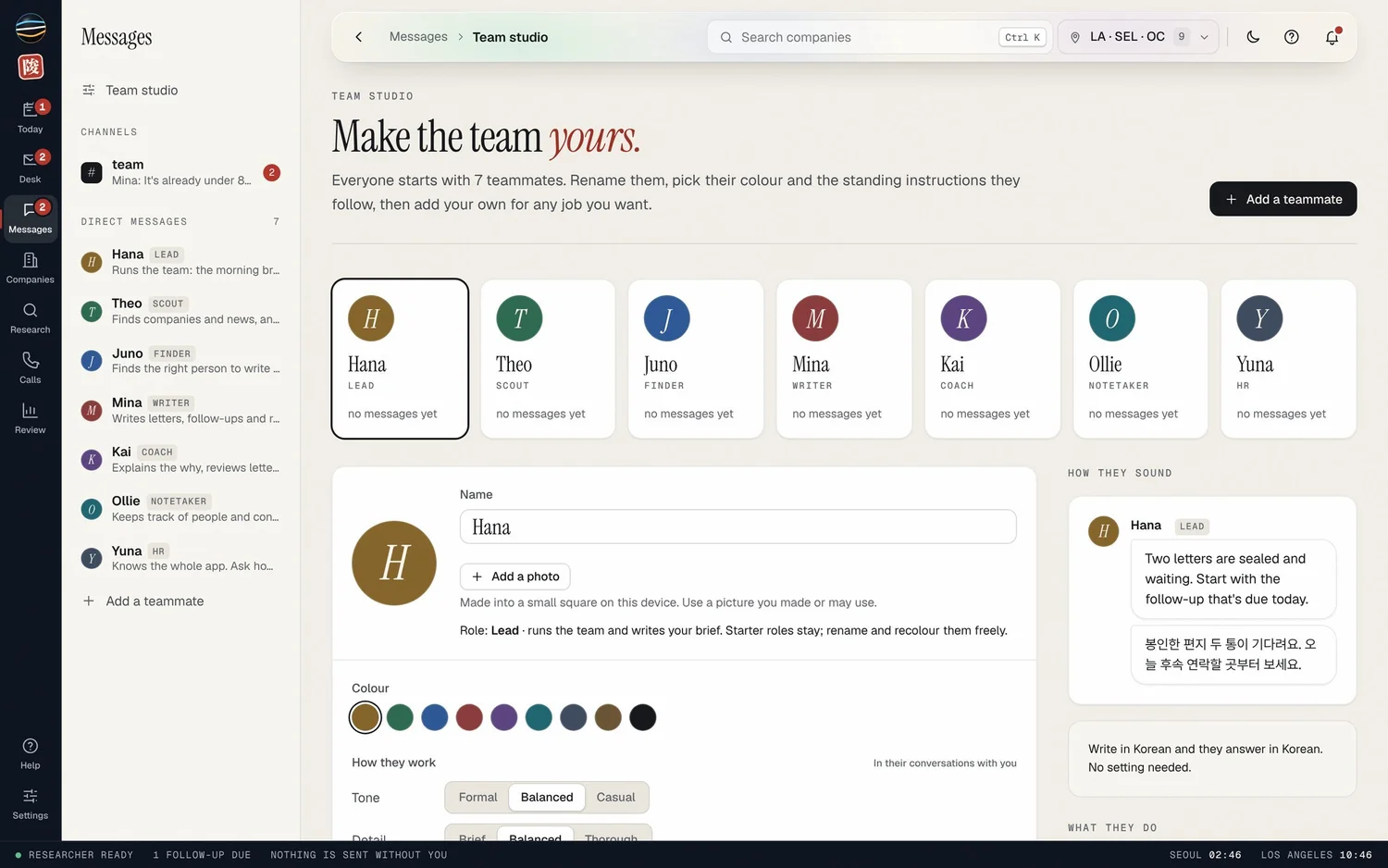
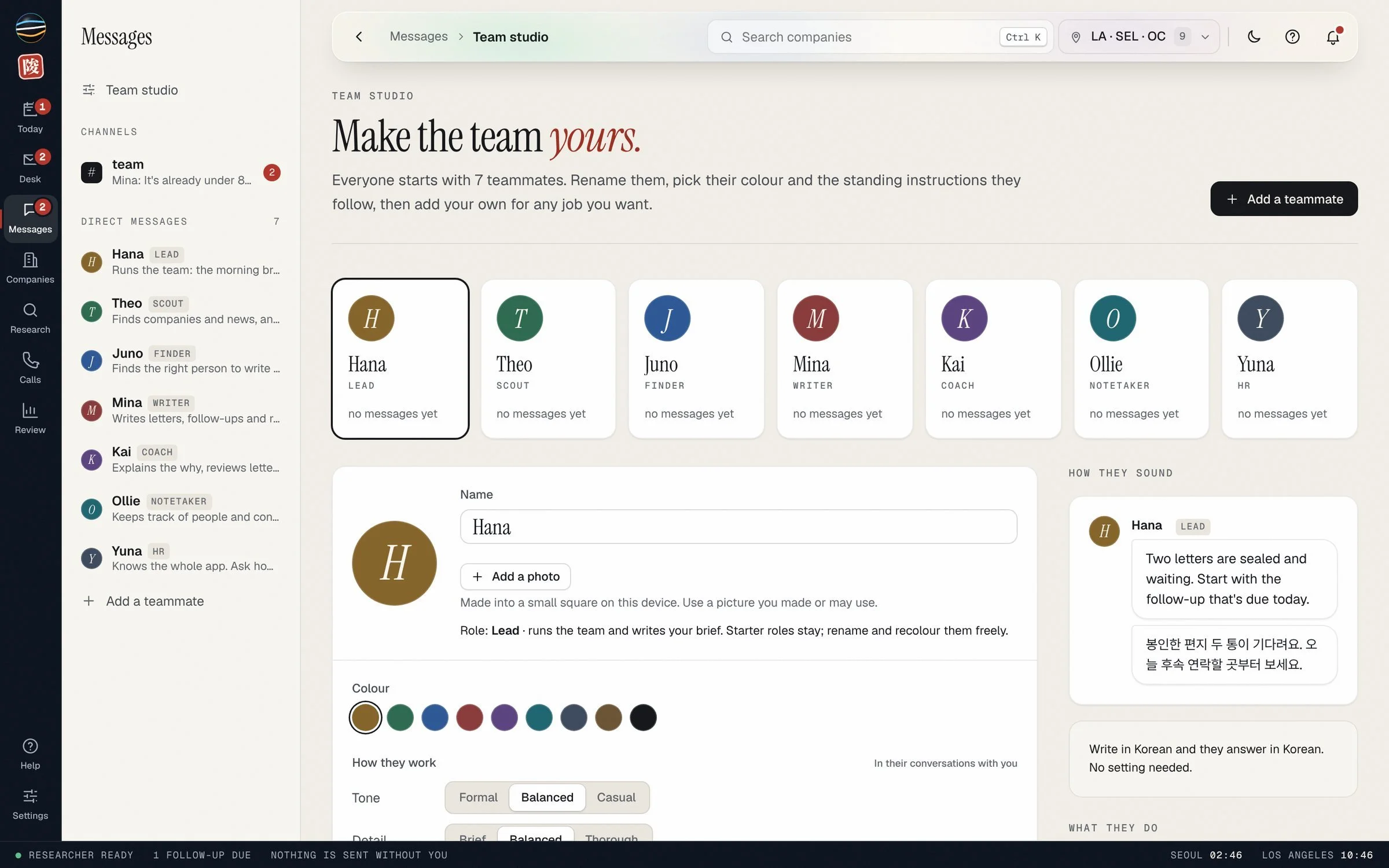
Not one assistant, but a team: each with a job, each checked by another. Each teammate has a name, a role and a channel of their own, and I can rename them or add my own. In #team the lead answers first and hands the work to whoever it belongs to. They can read the board but not change it, and they can’t send anything: anything to do comes back as a card with a button I tap. When one names companies in #team, another checks the claim against the files and says what doesn’t match.
| Teammate | Role | What they do, in the app’s own words |
|---|---|---|
| Hana | Lead | Runs the team: the morning brief, what to do today, and who should handle what. |
| Theo | Scout | Finds companies and news, and starts research runs that check every source. |
| Juno | Finder | Finds the right person to write to, from public professional pages. You confirm each name. |
| Mina | Writer | Writes letters, follow-ups and replies from the facts you’ve confirmed. |
| Kai | Coach | Explains the why, reviews letters before you seal them, and preps you for calls. |
| Ollie | Notetaker | Keeps track of people and conversations: what was said, promised and next. |
| Yuna | HR | Knows the whole app. Ask how anything works. |
Two more work behind the scenes. The Researcher searches the web and files what it finds with its sources. The checker opens every link and drops anything about a different company, any claim the page doesn’t support and any wrong date, before it reaches the board.
How it was made
From a list to a team, in nine days.
- IThe advice, and a listOct 16. My mentor’s advice, and a first page of 22 companies in LA and Orange County, in two lanes.
- IIA plan, out loudOct 21. On a walk, I talked through what it should be: one platform that does the work, shows me how, and is run by a team.
- IIIThe first versionOct 22. Sign-in, company files and the Writer, working end to end by morning.
- IVA complete redesignOct 22. It worked, and looked like a skeleton. A map of 37 pages in eight areas, two directions, and a mix of the two.
- VA human handOct 22 to 23. Three more prototype rounds, after I said it still felt made by AI.
- VIChecking the factsOct 23. Nine independent reviews in one night, then an audit of every claim on the board.
- VIISending, and fixes from useOct 24. Sealed letters can go out from my own Gmail at a time I pick. From using it: a shorter morning brief, blanks without brackets, English voices by default.
The look
Part private bank, part trading desk.
The brief I gave the redesign: high end and professional, like a financial institution, and a little technical. Two directions came back, a private bank and a trading desk, and I picked a mix. The first round still felt made by AI, so the next added a human hand: a red seal with my name in it, a handwritten signature, and proper Korean type.
- Paper#F2EFE8 · The page
- Ink#14161A · Text, the primary button
- Midnight#0D131E · The rail
- Seal#B5352A · The seal, what needs me
- Confirmed#2C6A4E · Checked against a page
- To check#8F5119 · Waiting for a look
- Info#2B5C9E · Notes and links
Checking the work
Tested from the outside, round after round.
On Oct 23, two independent reviewers read the code, one the server and one the app, and found 52 problems. Seven more rounds re-reviewed each set of fixes, 158 findings in all, in one night. Later that morning, at my request, independent auditors checked every claim on the board against the web, without seeing how the facts were made.
- 158findings, in one night52 from the first two reviewers; seven more rounds re-reviewed each set of fixes.
- 165/165wrong facts rejectedEvery wrong-fact case the reviewers found became a test, and the checker rejects all 165.
- 193claims auditedAcross 23 companies: 111 held up, and 10 were wrong or out of date.
- 0/7confirmed facts wrongNone of the facts the app had confirmed was wrong or out of date.
The audit, 193 claims
- 111held up
- 6wrong
- 4out of date
- 40not in the cited source
- 31couldn’t be checked
- 1nothing to check
The 6 wrong facts were all in files the checker had never run on. Most of the 40 not in the source were claims about me: openings that said more about my work than the Writer knew.
- 1The Writer describes my work only from my own facts. What a company’s research says about me is a suggestion, and new research keeps to the company’s side.
- 2My materials. The app reads my own pages, and I approve each fact about me before it’s used. When a page changes, facts whose words are gone stop being used until I look at them.
- 3Edit facts. A fact I change loses its check and my OK until it’s checked again, and the old version is kept.
- 422 corrections to the board.
The design
Research, check, write, seal.
Screens from the demo, which runs on made-up companies and people.
 1
2
3
4
5
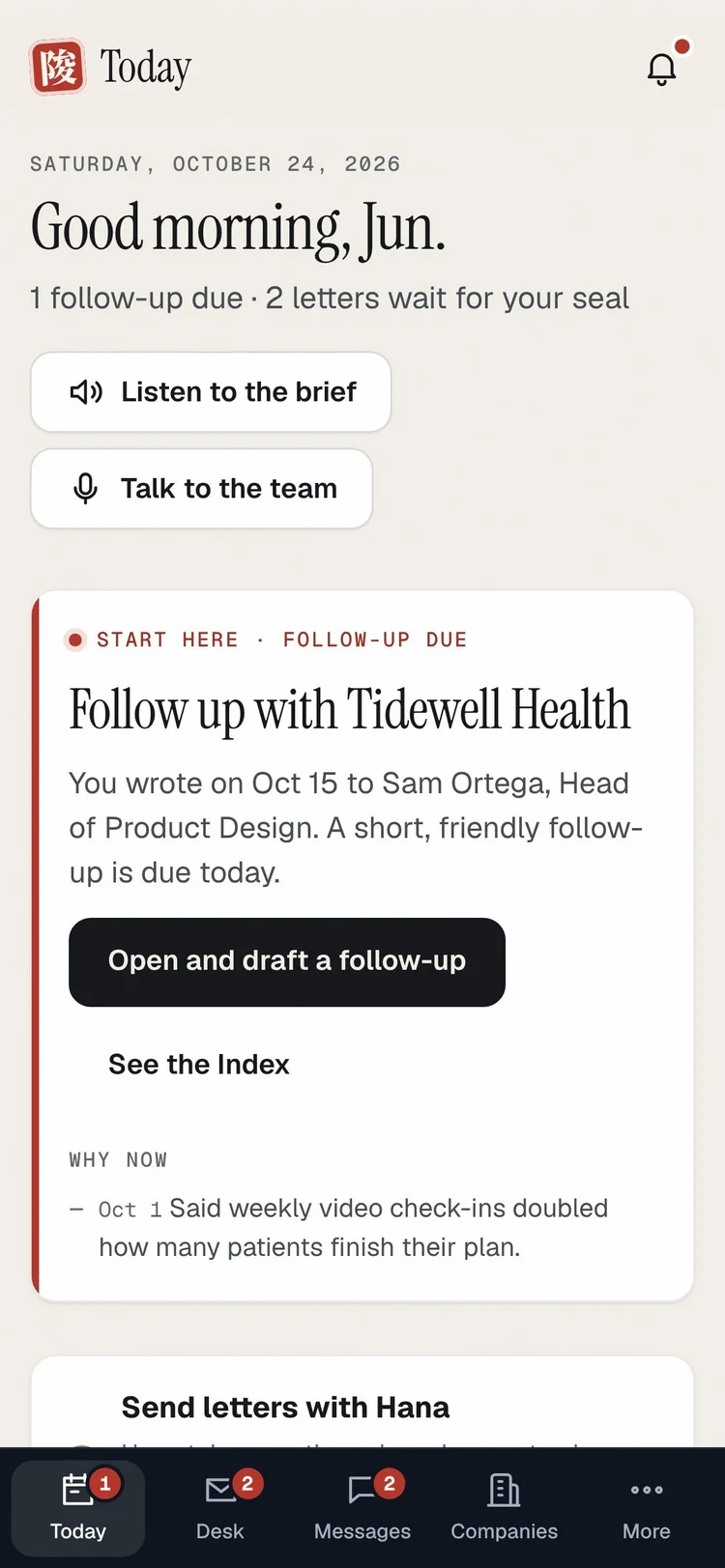
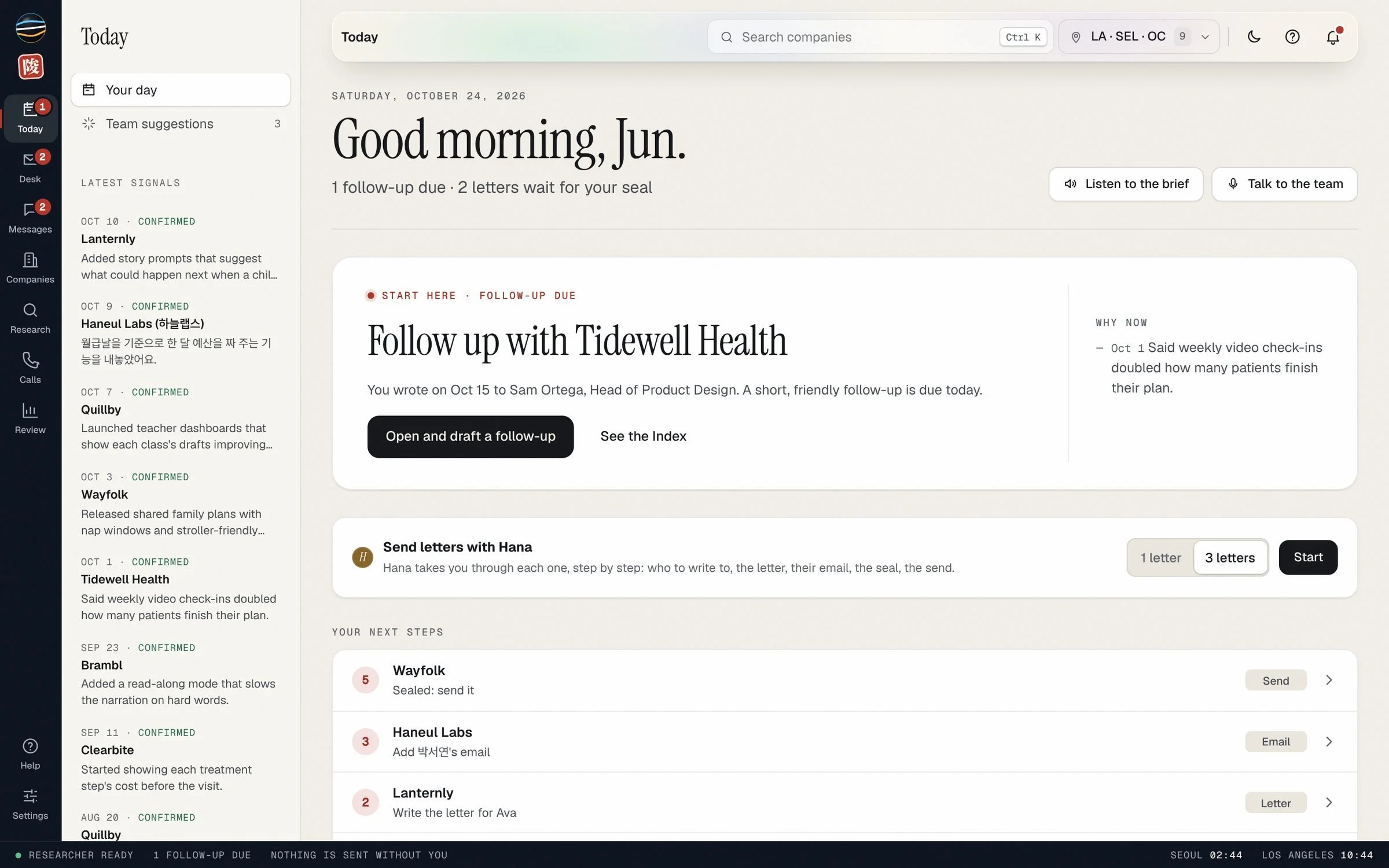
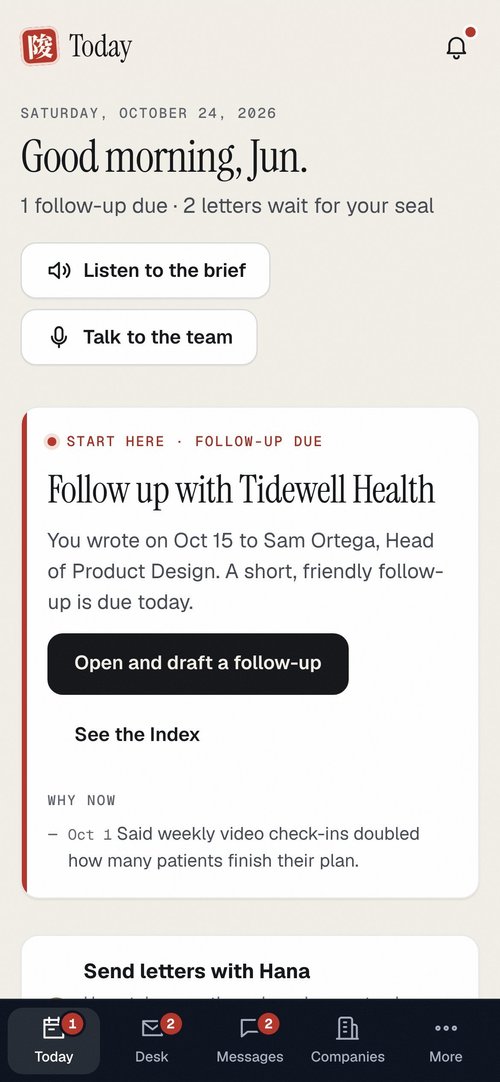
01The day starts with one thing to do.
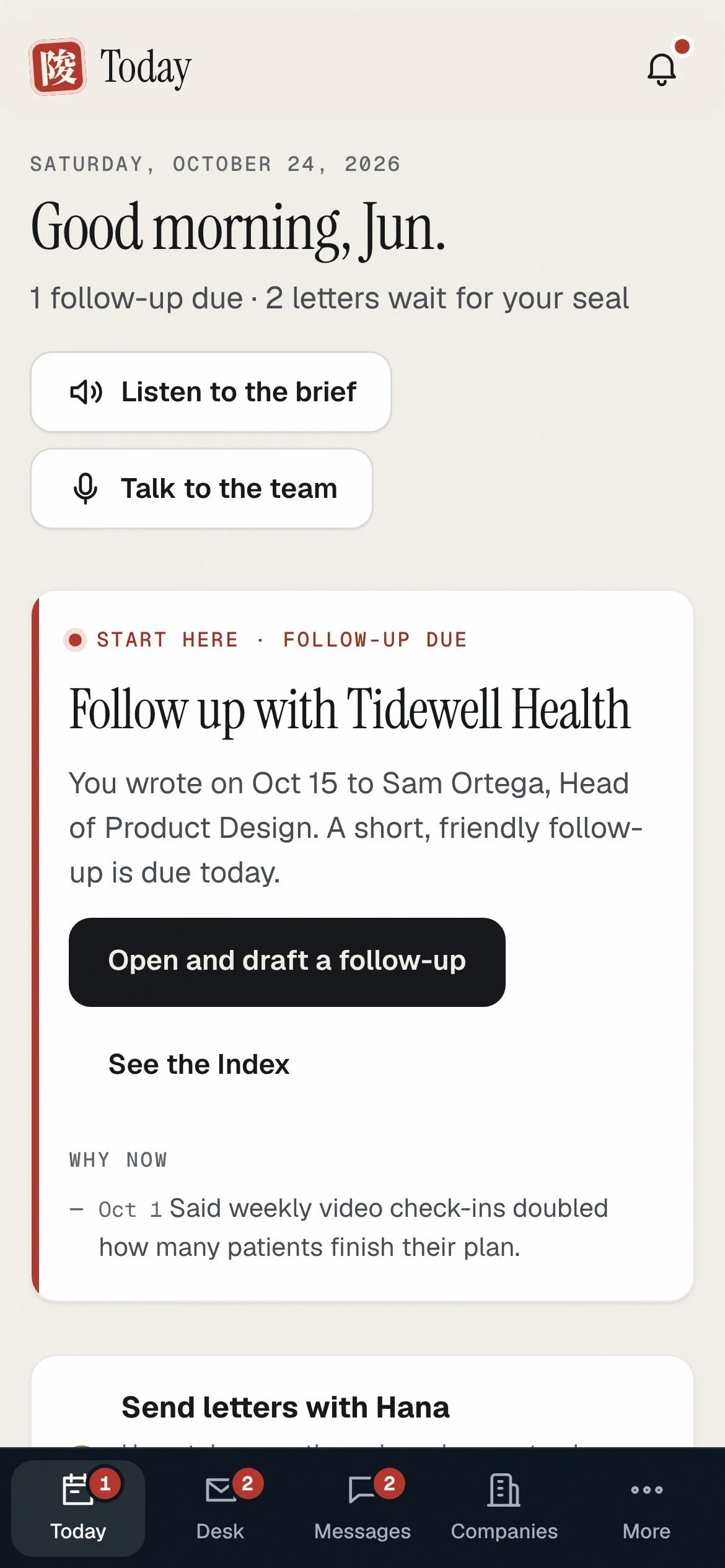
- 1The first card is the one thing to do now: here, a follow-up that’s due, with who it goes to and when.
- 2Why now, with the date of the source it rests on, so a reason never arrives without its evidence.
- 3Send letters with Hana: the lead walks through each letter step by step: who to write to, the letter, their email, the seal, the send.
- 4The next step for each company, numbered by how far along the five steps it is.
- 5Latest signals: news from the companies on the board, each one marked Confirmed and dated.
 1
2
3
4
5
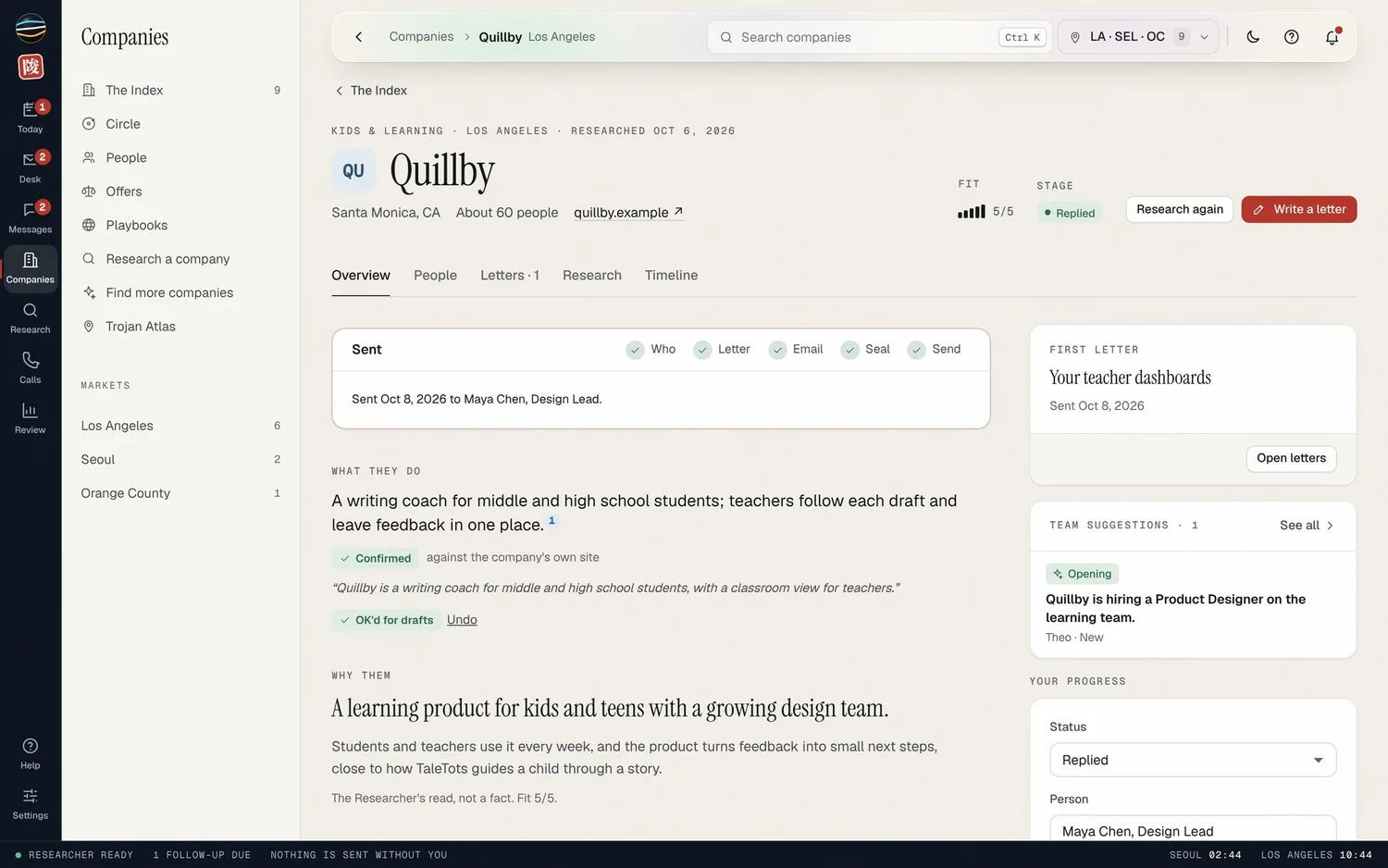
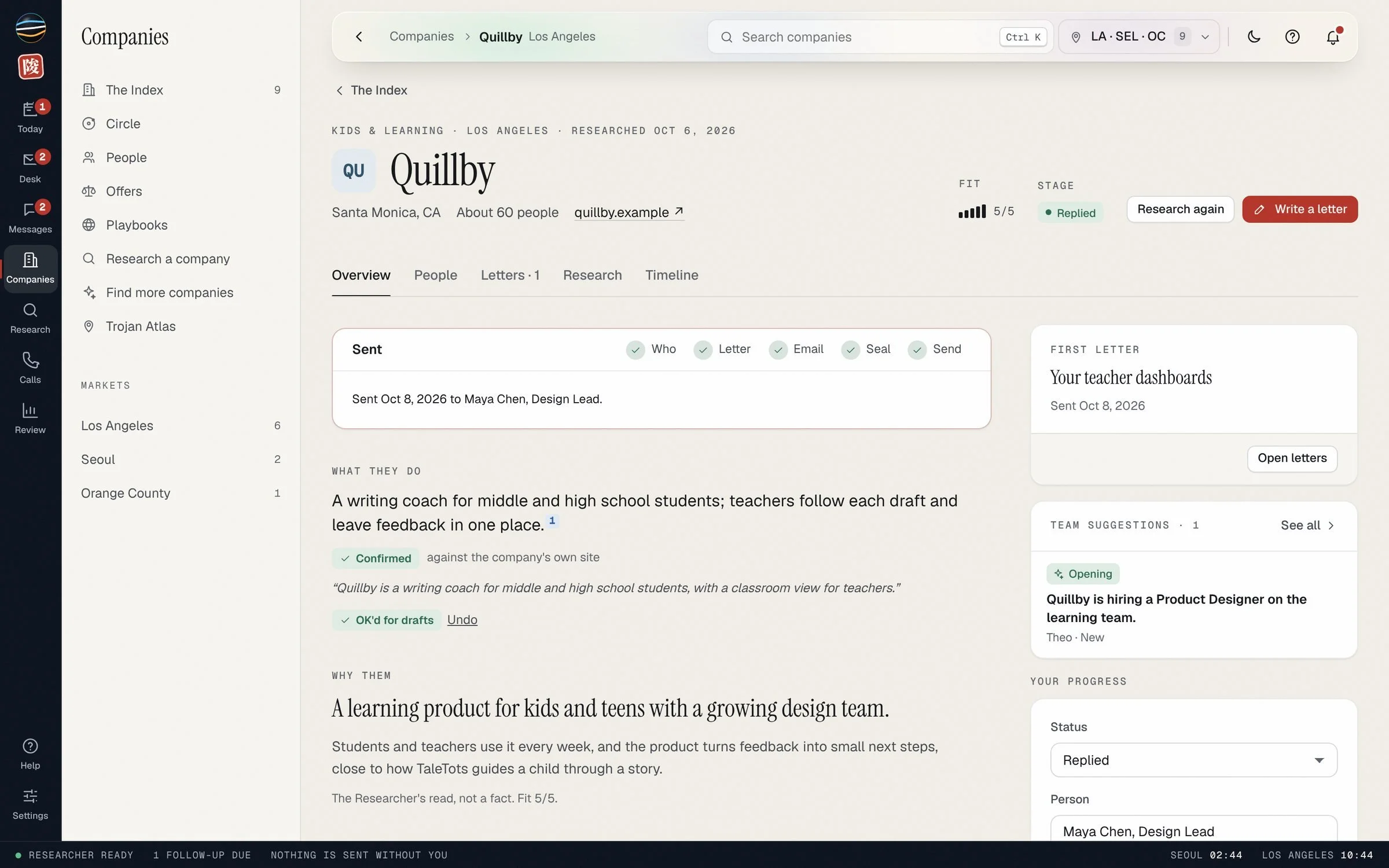
02Every fact shows where it came from.
- 1What the company does, in one sentence with a numbered source.
- 2Confirmed against the company’s own site, with the quote that was found on the page.
- 3OK’d for drafts, with Undo. Until I tap OK, the Writer can’t use it.
- 4Why them: the Researcher’s argument, labelled “The Researcher’s read, not a fact.”
- 5The five steps to a sent letter: who, letter, email, seal, send.
 1
2
3
4
5
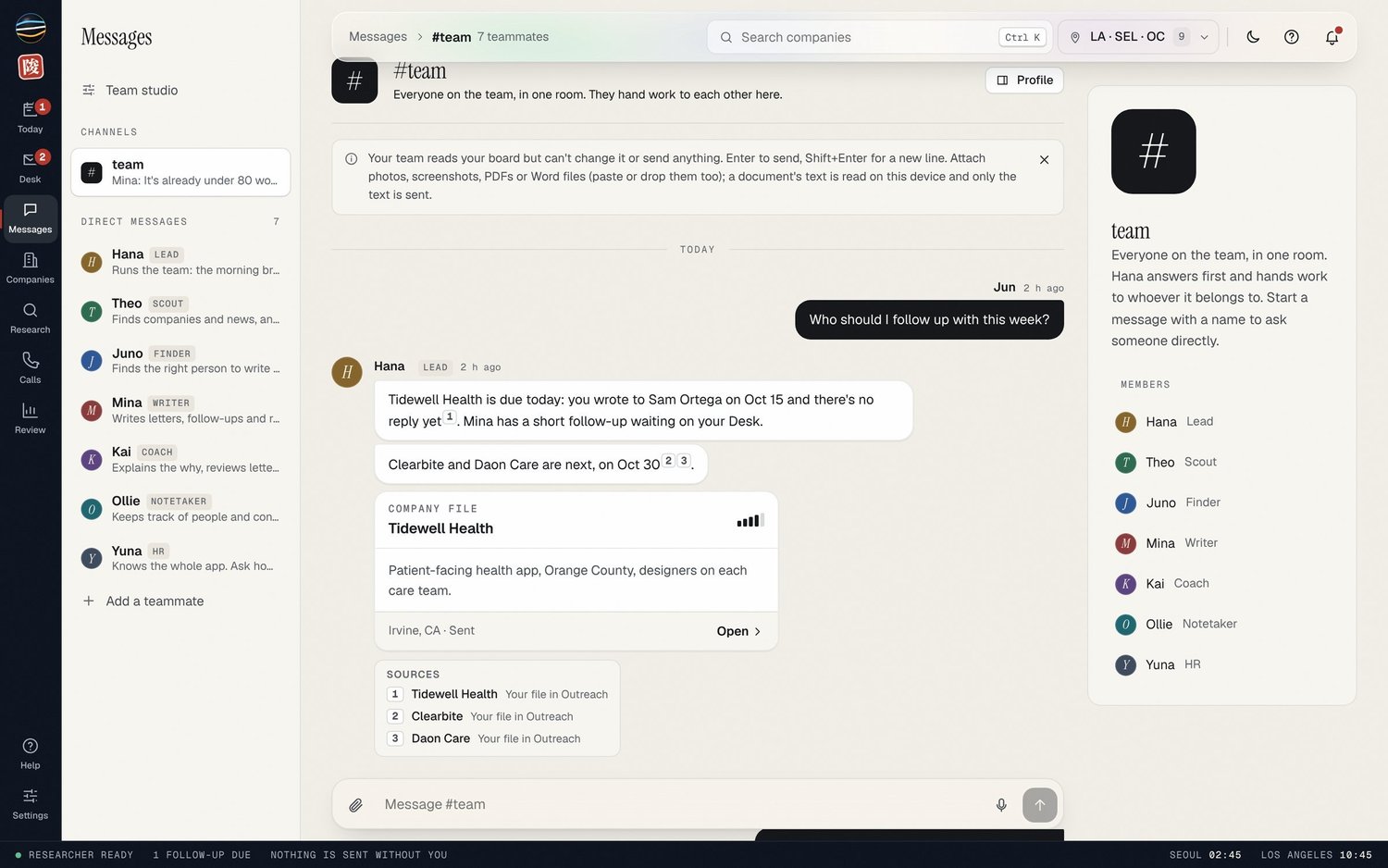
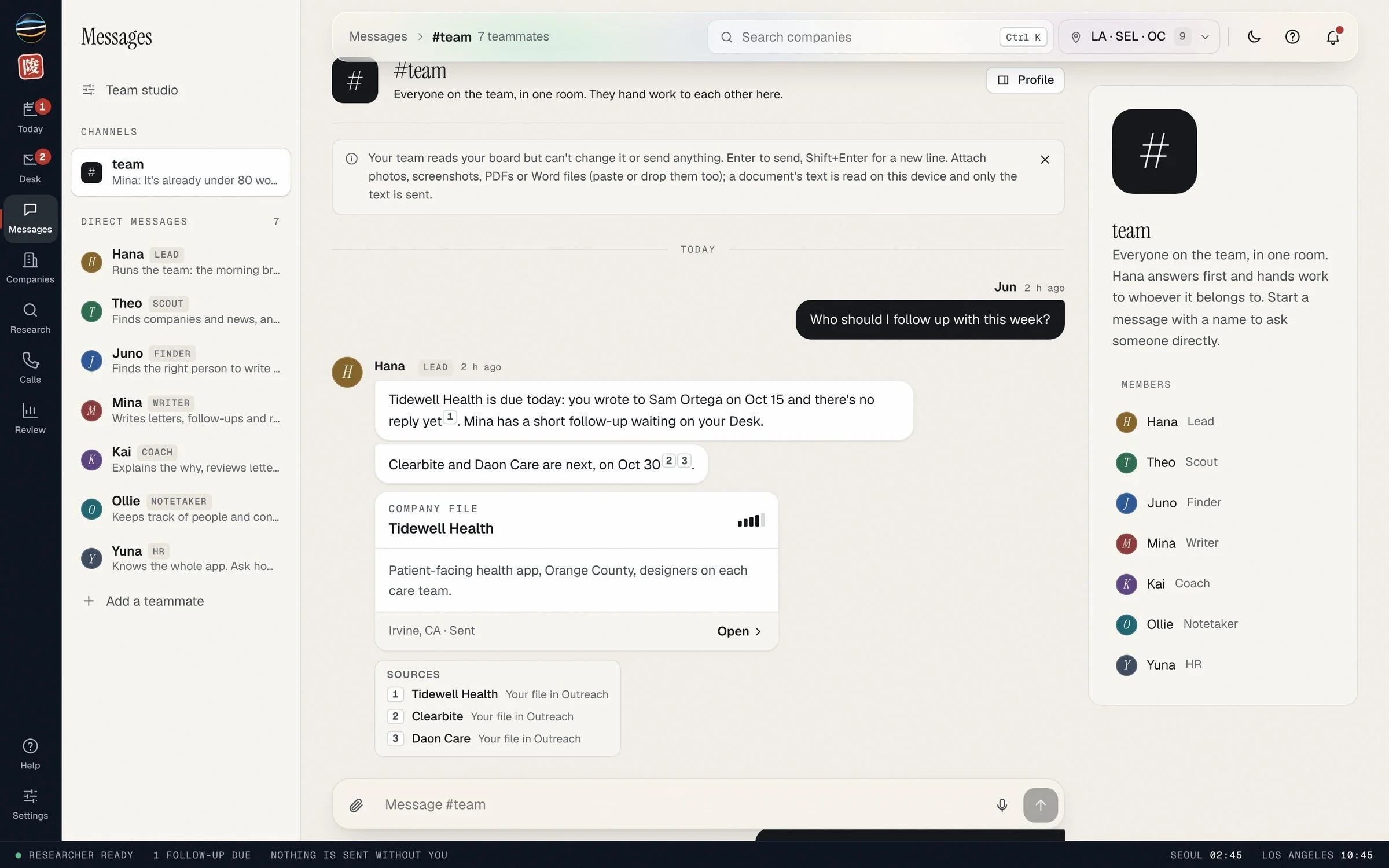
03A team in one room.
- 1The rule, said up front: the team reads the board but can’t change it or send anything.
- 2I ask #team; Hana, the lead, answers first and hands work to whoever it belongs to.
- 3Anything to do comes back as a card I tap, here the company file to open.
- 4Numbered sources under the reply. A link that isn’t a board page the teammate saw is dropped.
- 5Seven members, each with a role, renamed and recoloured as I like.
 1
2
3
4
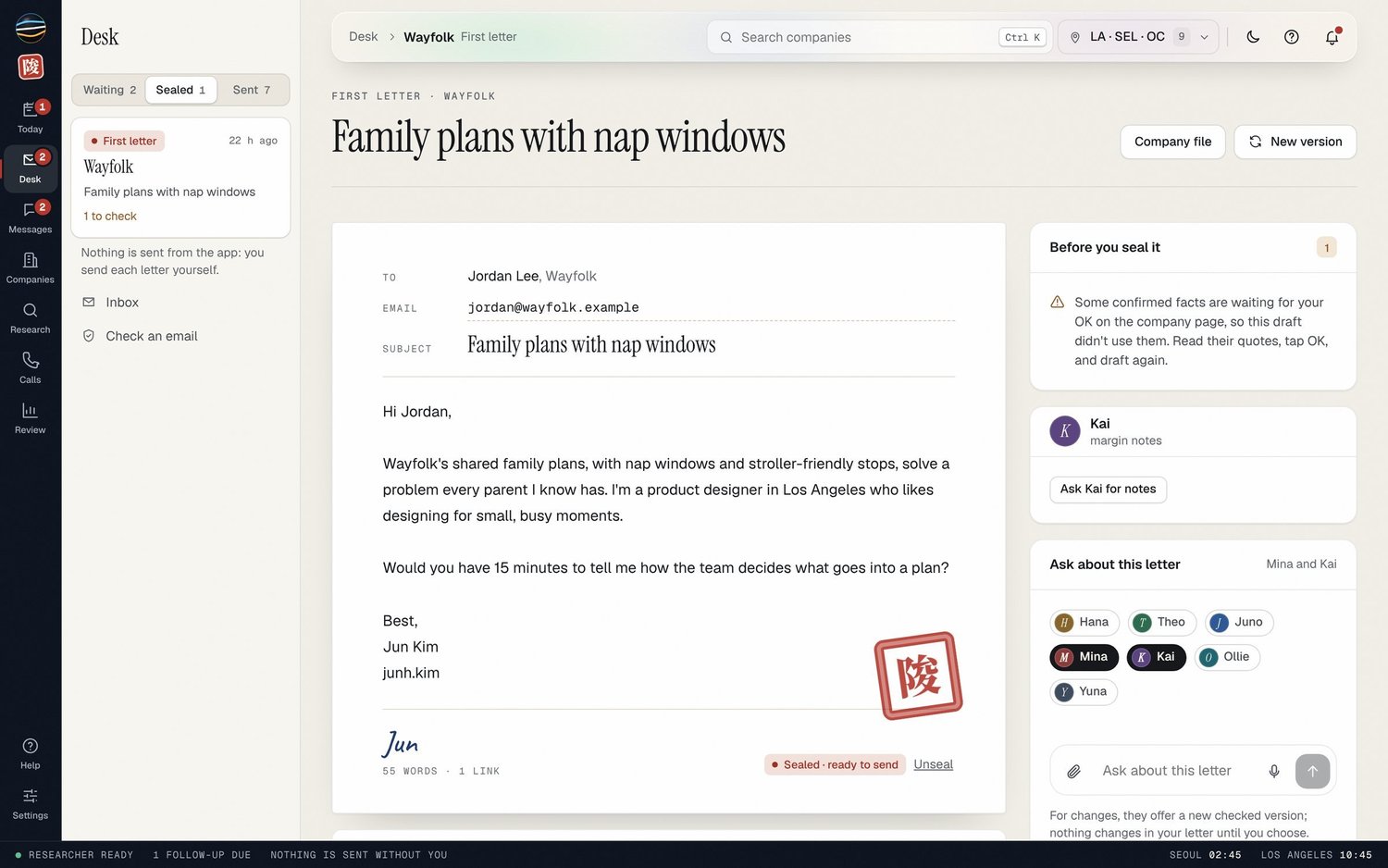
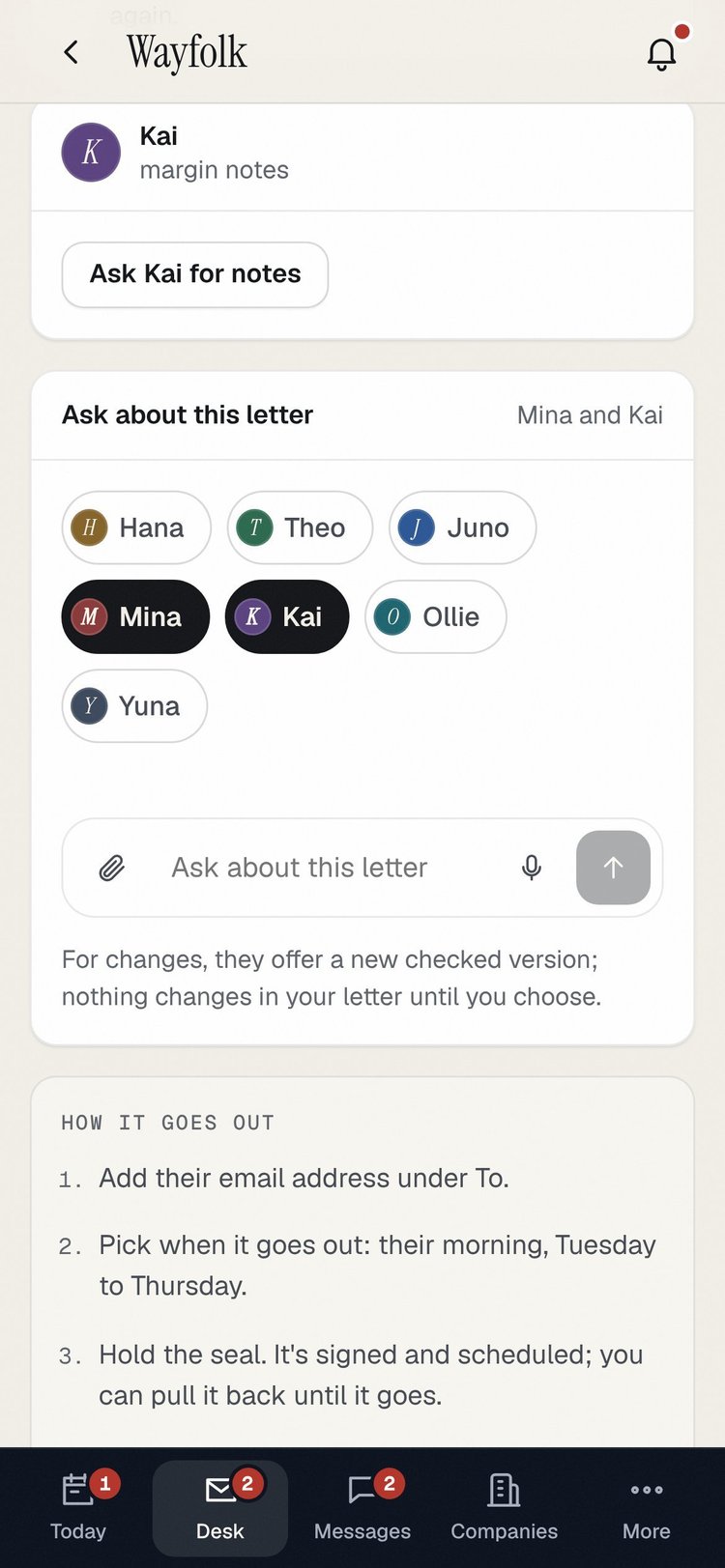
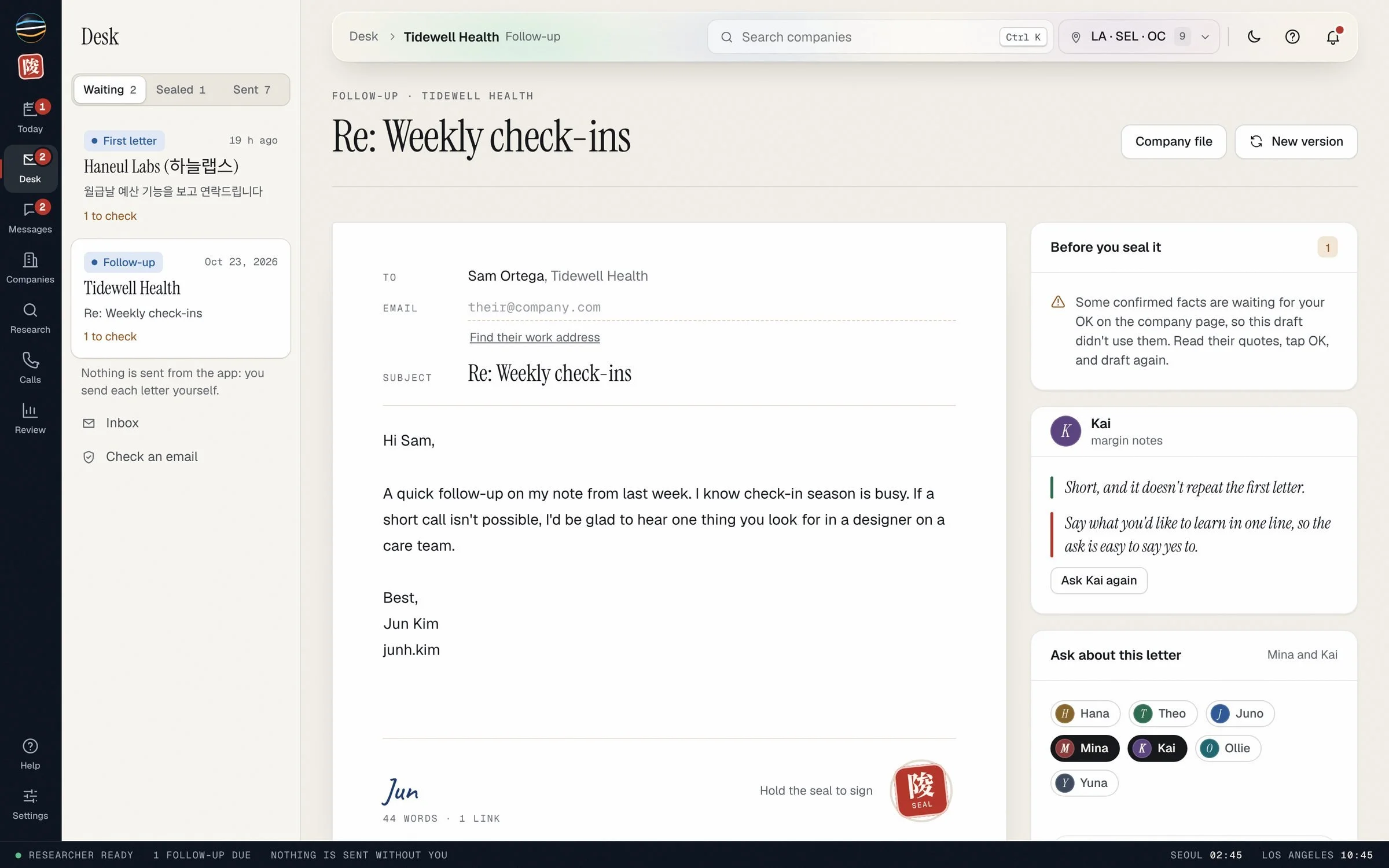
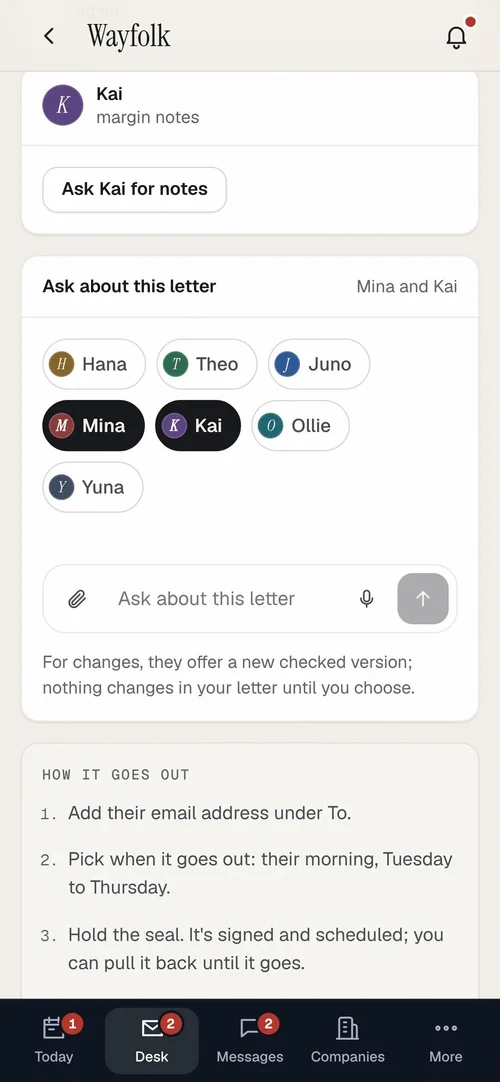
04A letter that waits for me.
- 1Before you seal it: what’s still open. Here, confirmed facts are waiting for my OK, so the draft left them out.
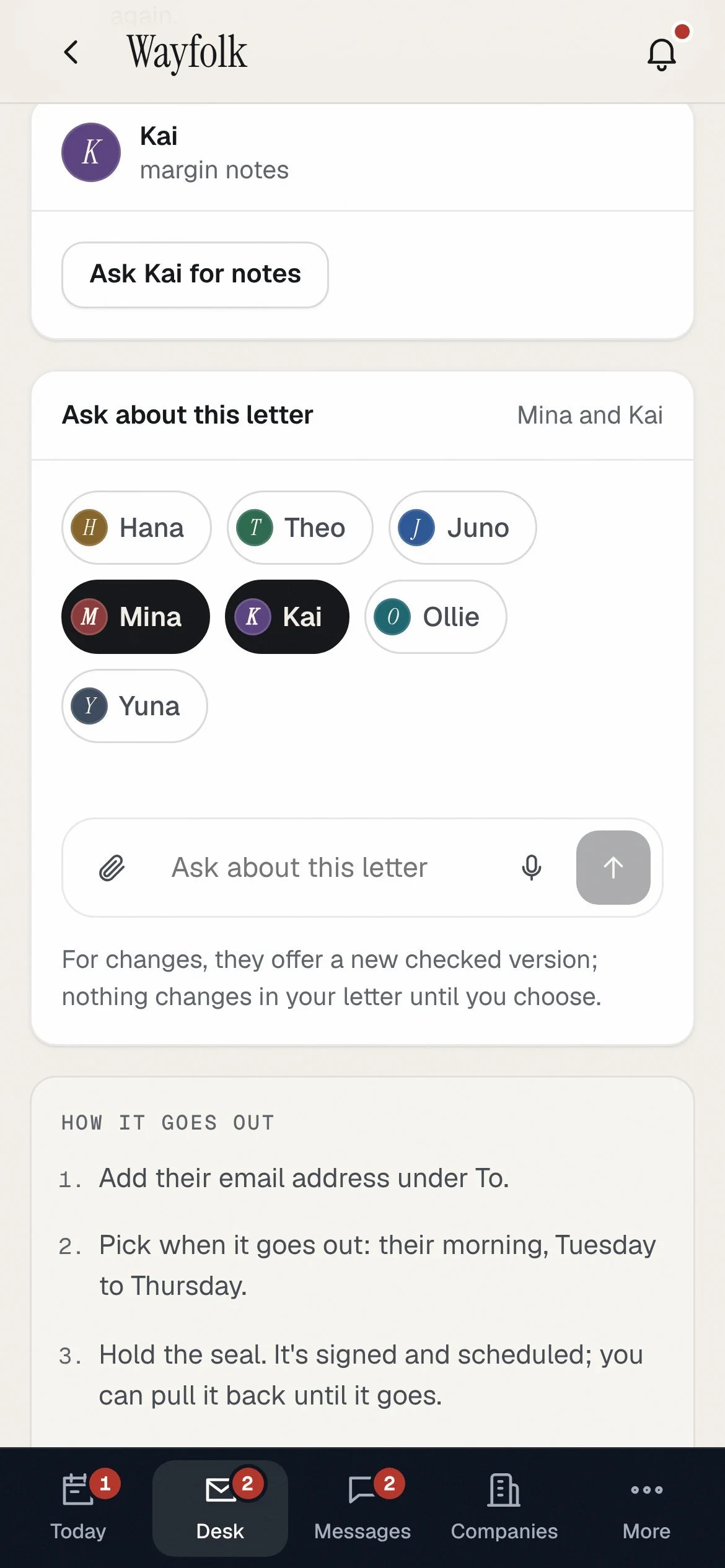
- 2Kai’s margin notes: what works, and one thing to change before it goes.
- 3Ask about this letter: Mina and Kai answer, changes come back as a new checked version, and nothing changes until I choose.
- 4Hold the seal to sign. With a blank or a note still in the letter, it won’t seal.
1
2
3
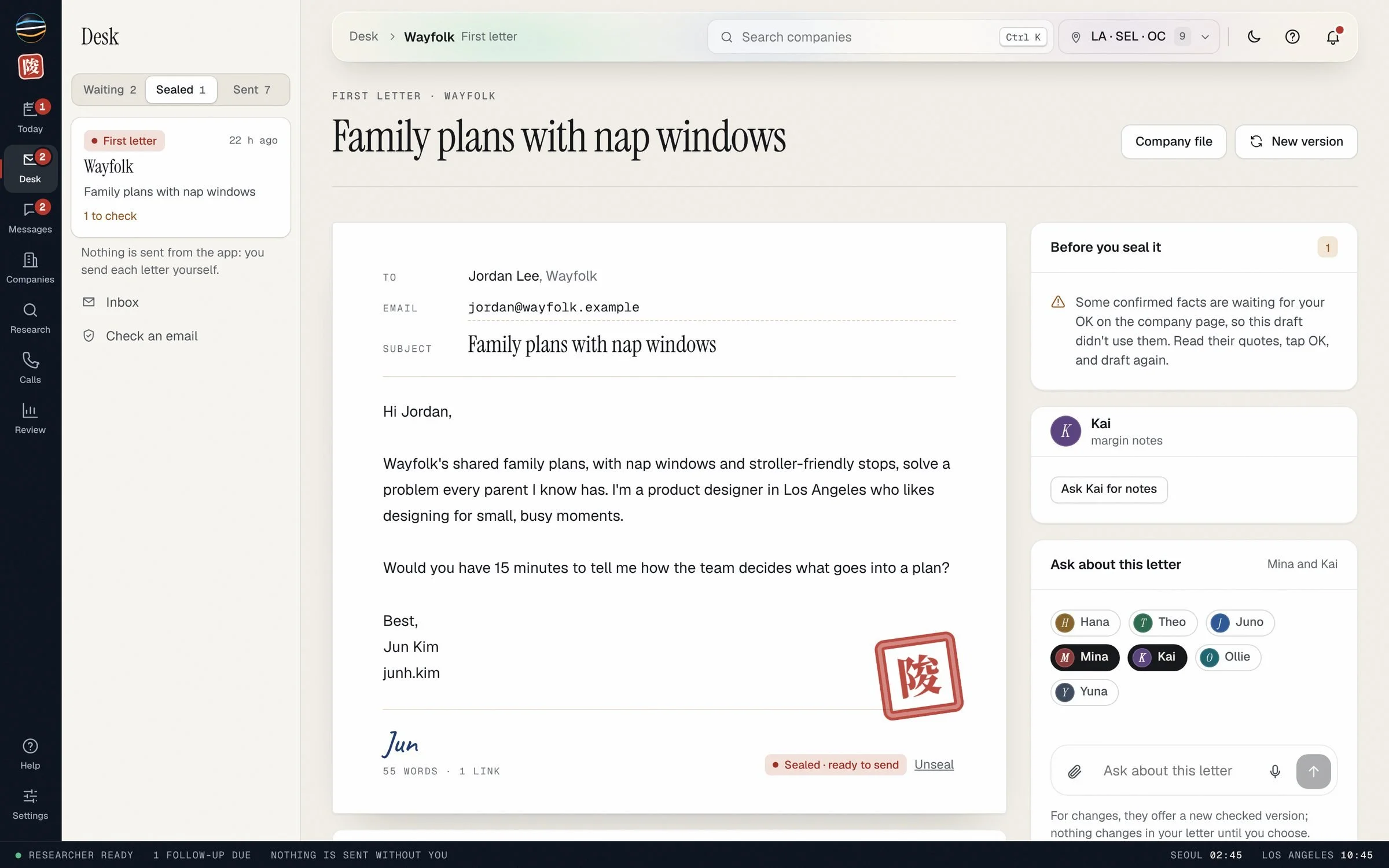
05Hold to seal.
- 1The seal, stamped once I’ve held it down: I read this letter, and it’s right.
- 2Sealed, ready to send, with Unseal beside it. Any edit breaks the seal.
- 3Sealed letters wait in their own tab. One goes out at the time I pick, and I can pull it back until it does.
 1
2
3
4
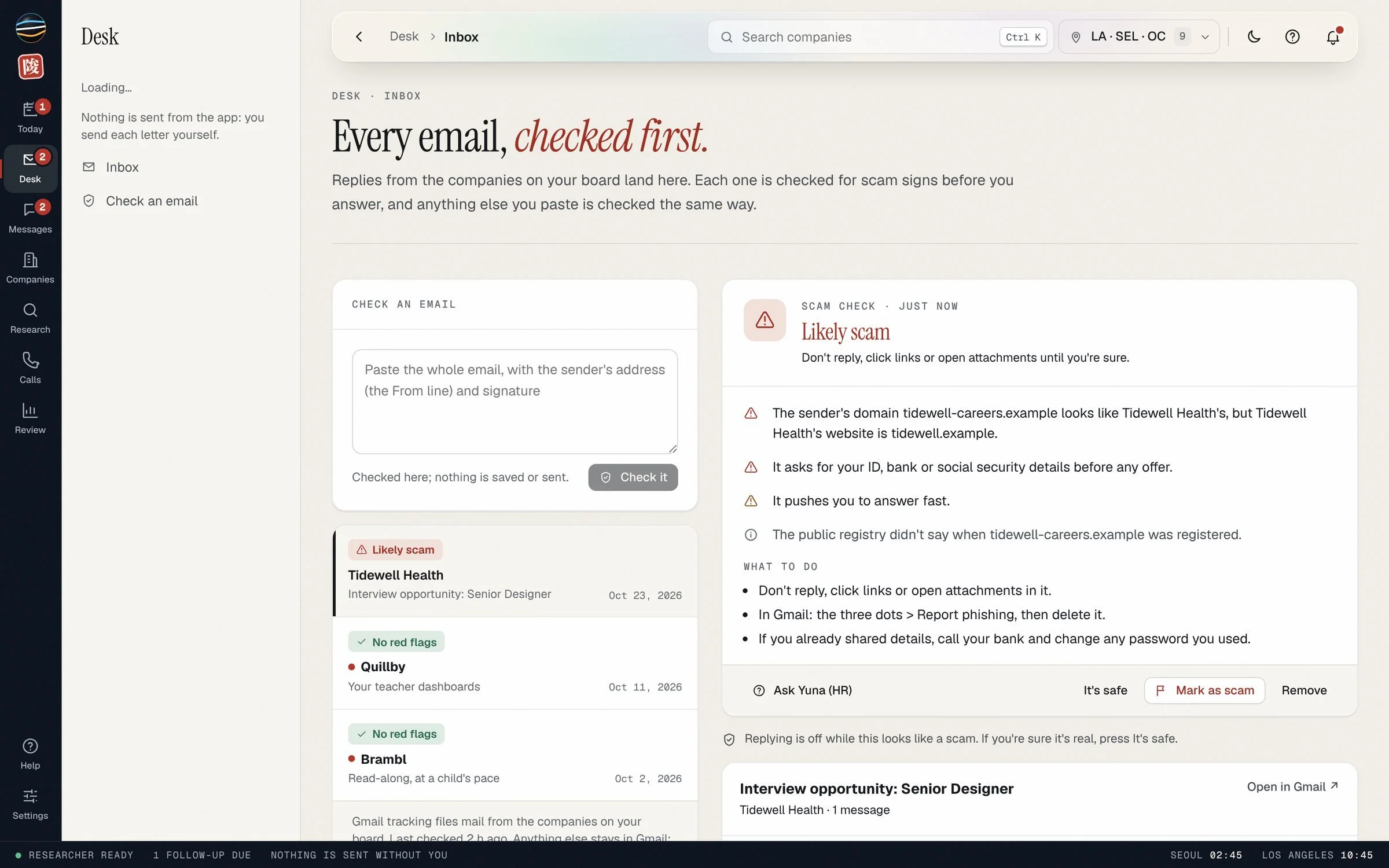
06Every email, checked first.
- 1Paste any email to check it. Nothing is saved or sent.
- 2A reply that looks like a scam is flagged in the list before I open it.
- 3What’s wrong, line by line: a look-alike domain, a request for ID or bank details, pressure to answer fast. Plain rules, no AI.
- 4Replying stays off while it looks like a scam, until I say it’s safe.
Try it
The real interface, with made-up companies.
Open a company file, read a letter, hold the seal.
The demo is built from the app itself and runs in your browser. Nothing is sent and nothing leaves the page. The team’s answers are written in advance and a research run is simulated, so the AI parts are shown, not live. For the full view, open it on a computer.
- Live research. The Researcher searches the web and the checker opens every page, in one to two minutes.
- A team that answers. Each teammate works from its role, my standing instructions and the board, which it can read but not change.
- Sending from my own Gmail. A sealed letter goes out at the time I pick, and I can pull it back until it does.
- Replies, filed and checked. Replies land under their company, checked for scam signs before I answer.
Where it stands
In use, and early.
- 1In use since Oct 22, and still early.
- 2Built for more than me. People I invite get their own private board, set up in Korean or English, with a monthly spend cap.
- 3It learns only what I keep. The Writer proposes lessons from my edits, and a lesson reaches it only if I keep it.
- 4Both languages. Research in Korea or the US, letters in Korean or English, and teammates who answer in the language I write in.
The whole collection
Every screen, at full size.
Scroll sideways. Each one opens at full size in a new tab. All from the demo, with made-up companies and people.
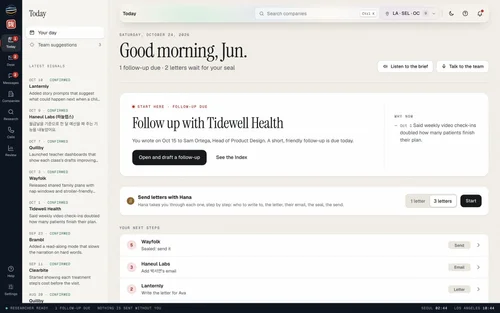 Desktop Today
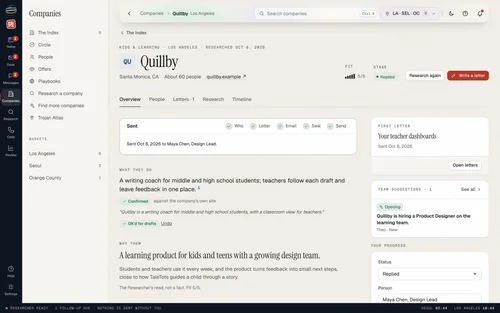 Desktop A company file
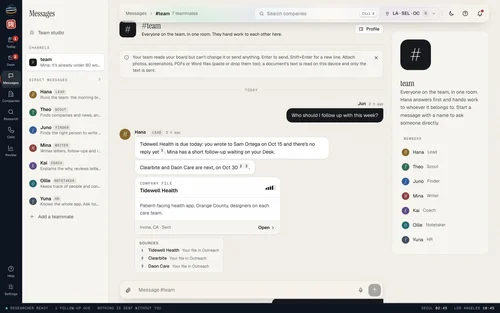 Desktop #team
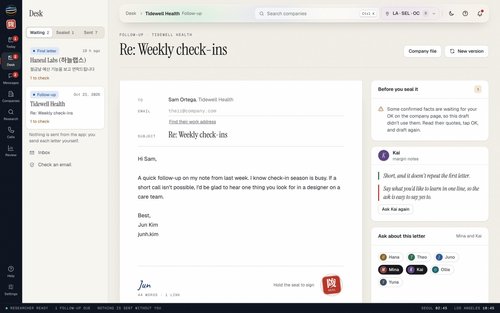 Desktop A letter, waiting for the seal
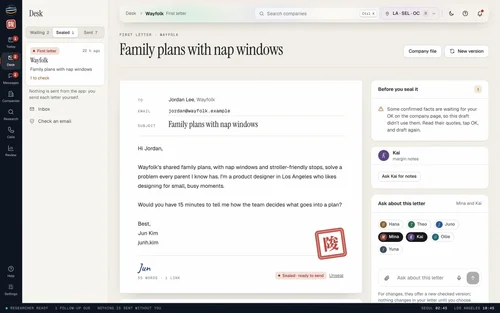 Desktop A sealed letter
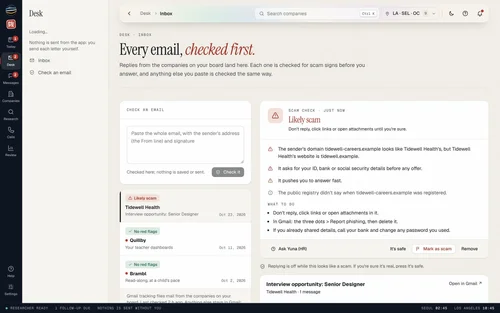 Desktop The inbox, a scam flagged
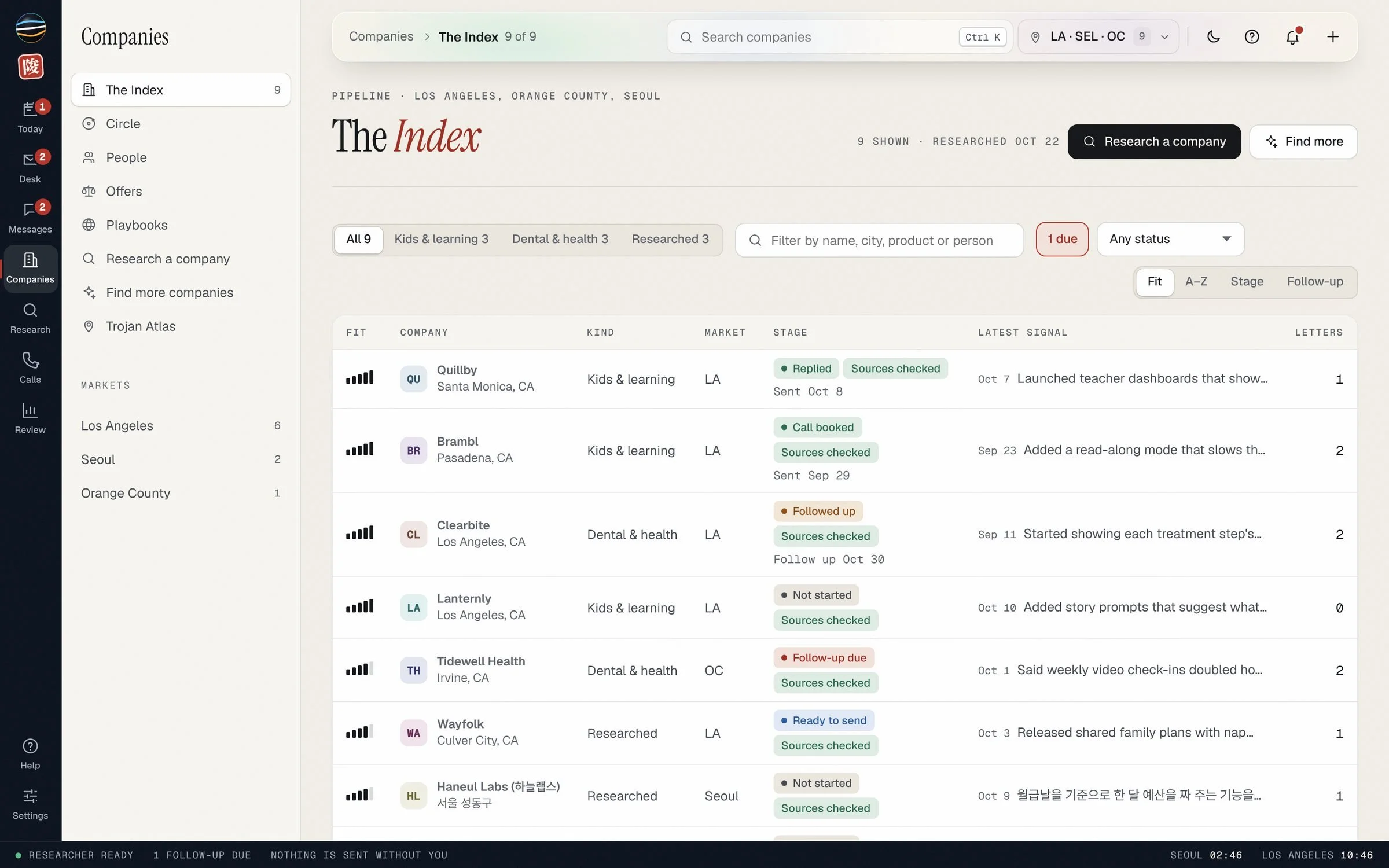
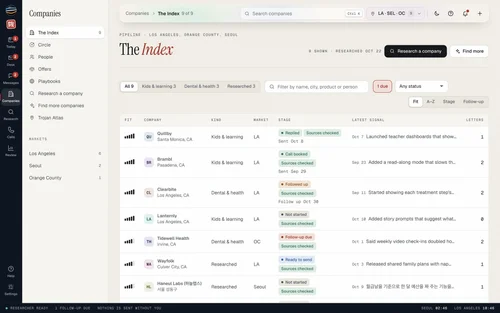 Desktop The Index
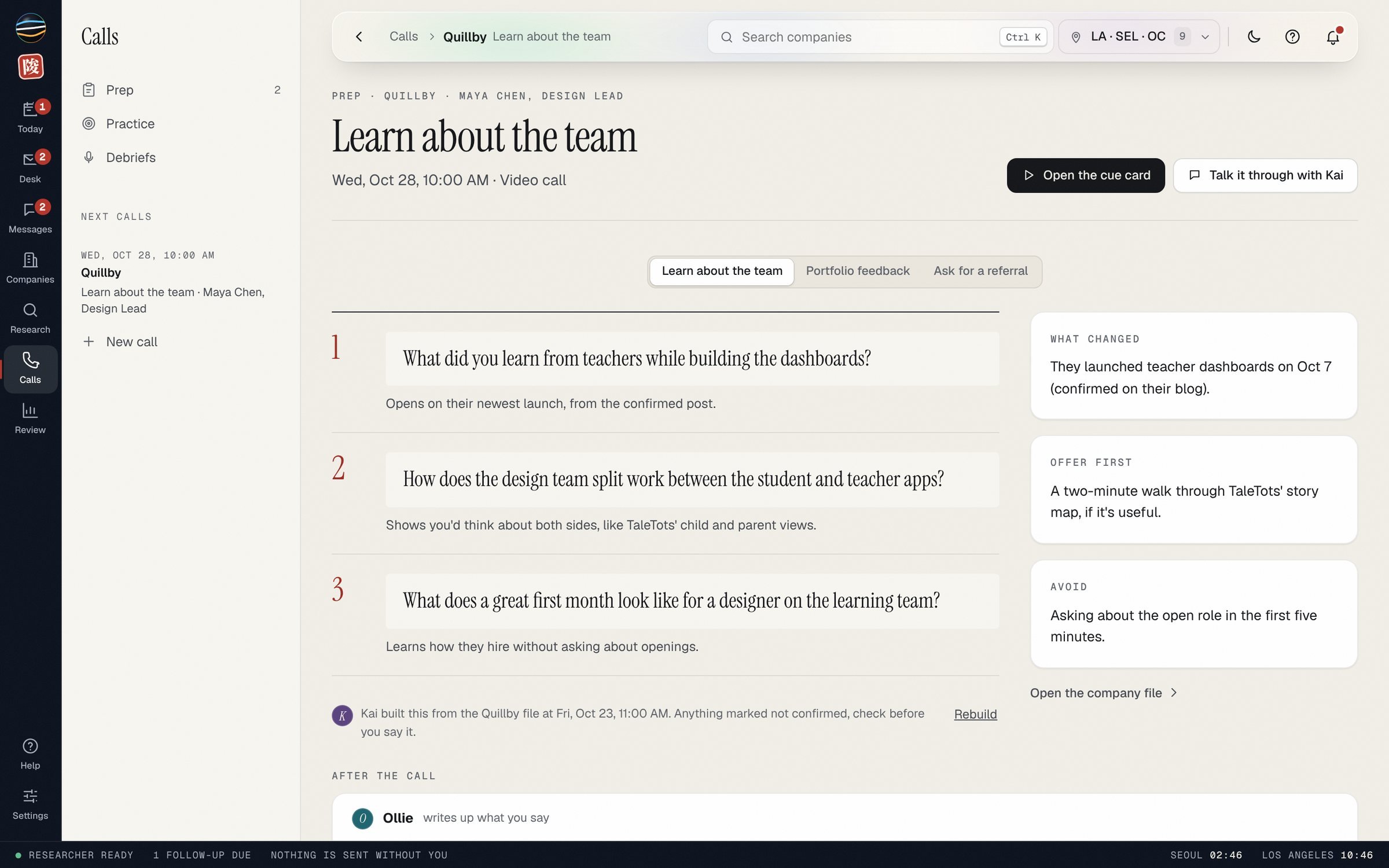
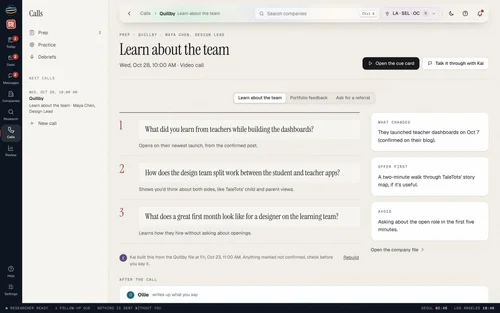 Desktop Prep for a call
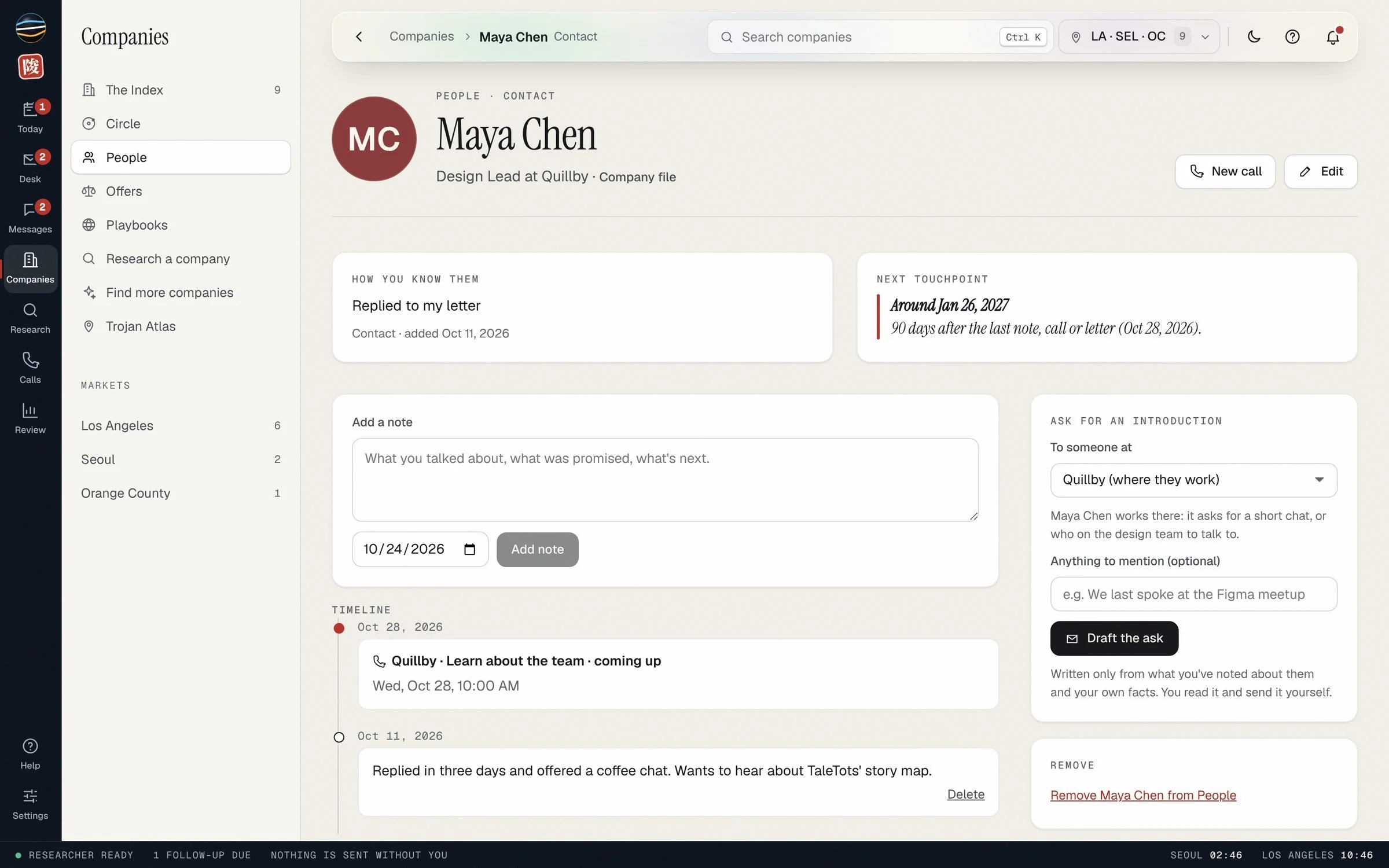
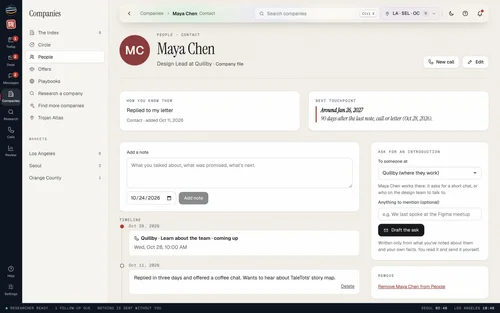 Desktop A person
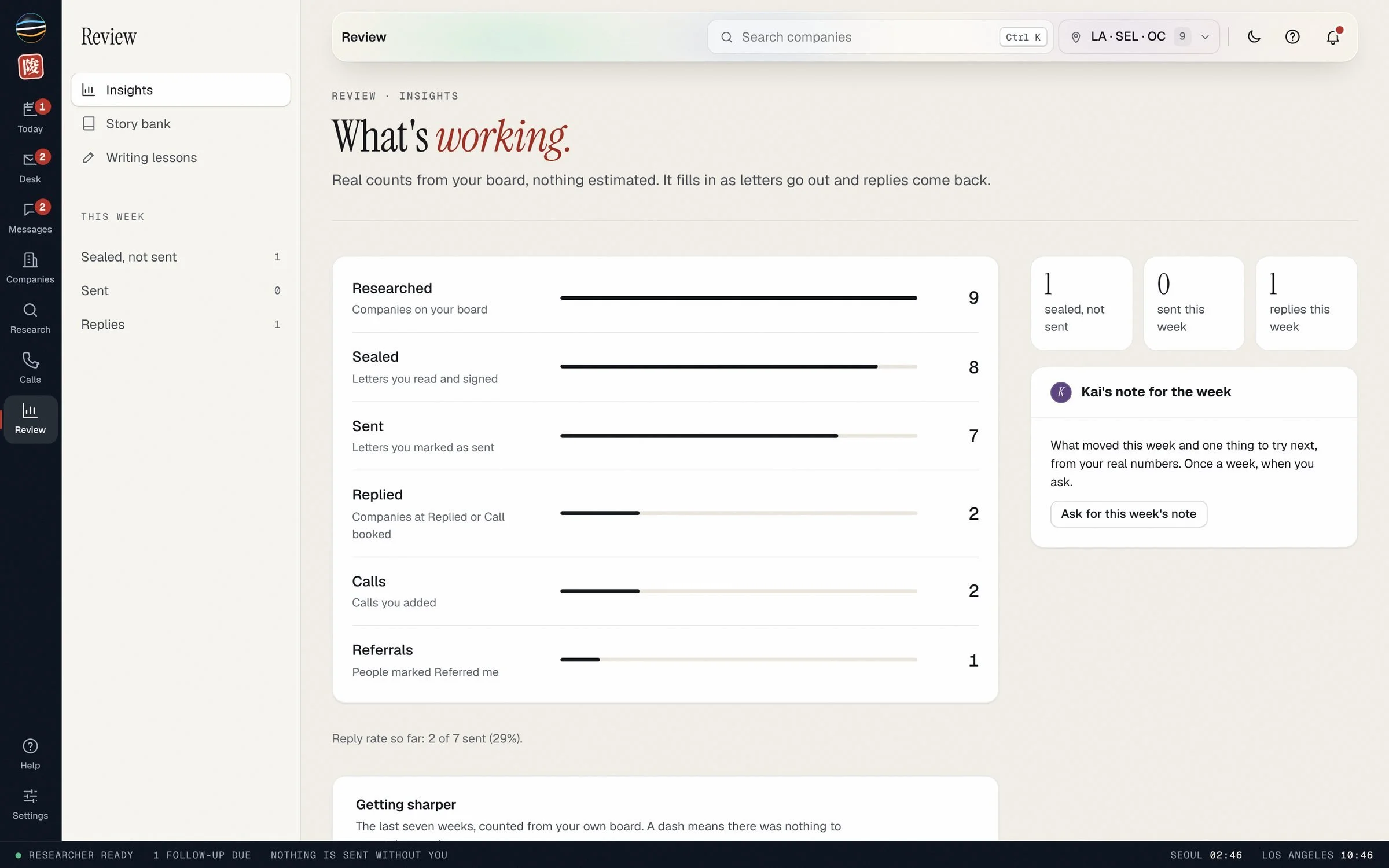
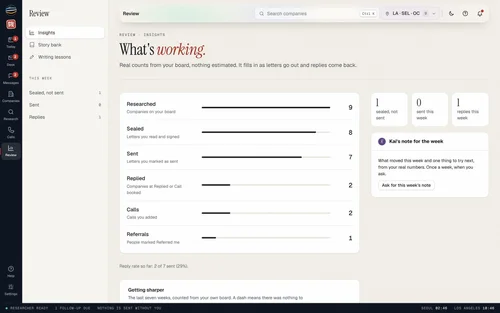 Desktop Review
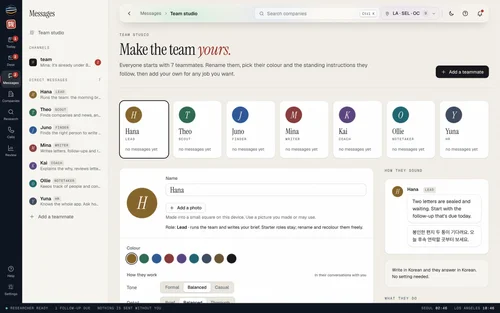 Desktop Team studio
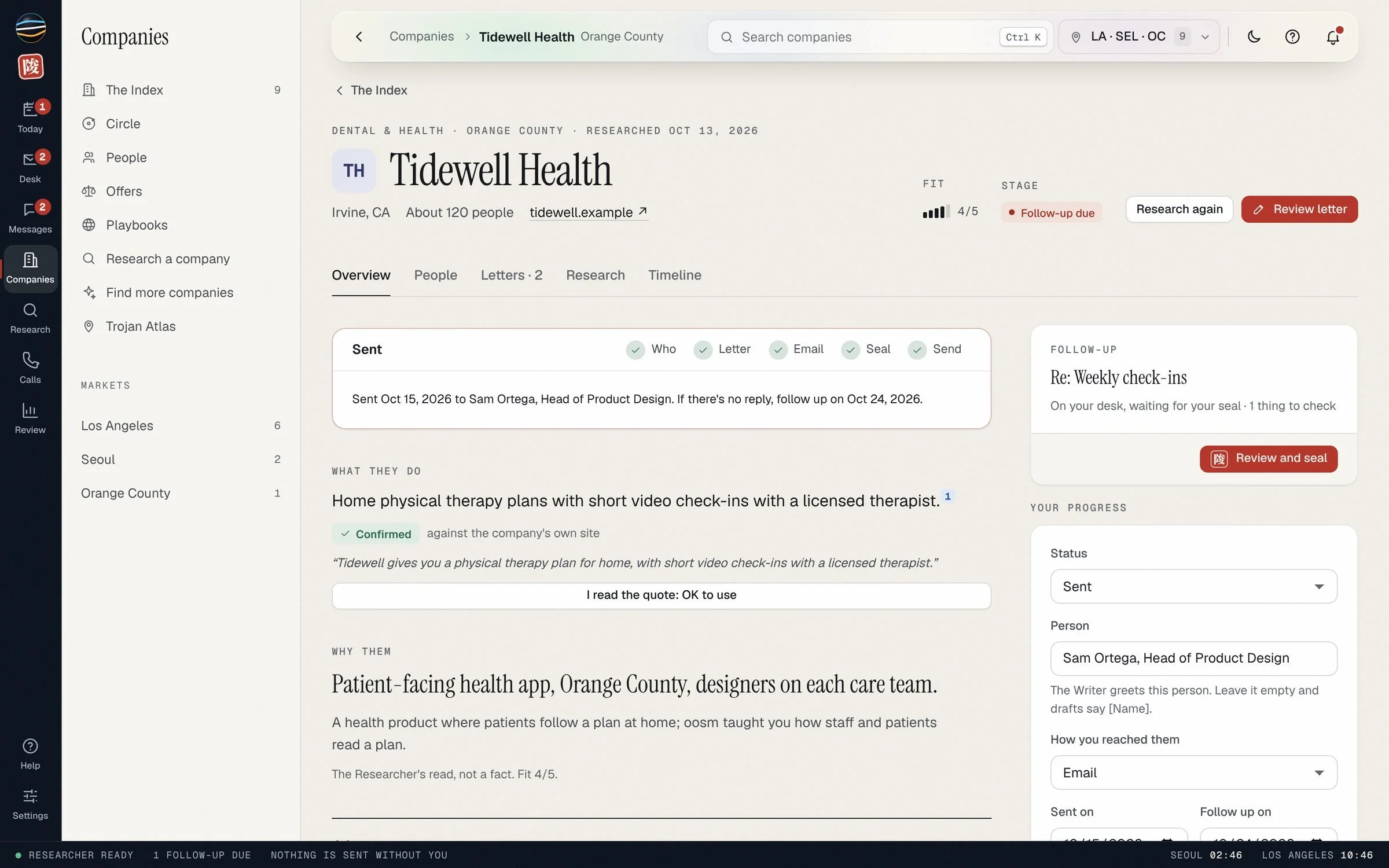
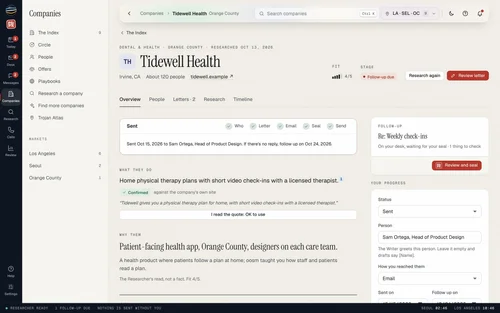 Desktop Another company file
 Phone Today
 Phone How a letter goes out
What I learned
Trust is earned one fact at a time.
- One badge can’t vouch for a whole company. The OK belongs to one fact, one page and one quote, so a single wrong line can’t hide behind the rest.
- A label is a design decision. “The Researcher’s read, not a fact” tells me how much weight a line can carry.
- A blank beats a guess. When no checked fact fits, the letter keeps a highlighted blank, and it won’t seal until I fill it.
- Test the old work too. The errors weren’t in what the checker had confirmed. They were in files it had never run on.
- Make the last step a person’s. Holding to seal takes a second, and it’s the second where I read the letter.
- Design the team, not the tool. Roles made it clear who to ask, and who checks whom.
Outreach argues that an AI team is worth trusting only as far as it shows its sources, and that the last step should always be a person’s.